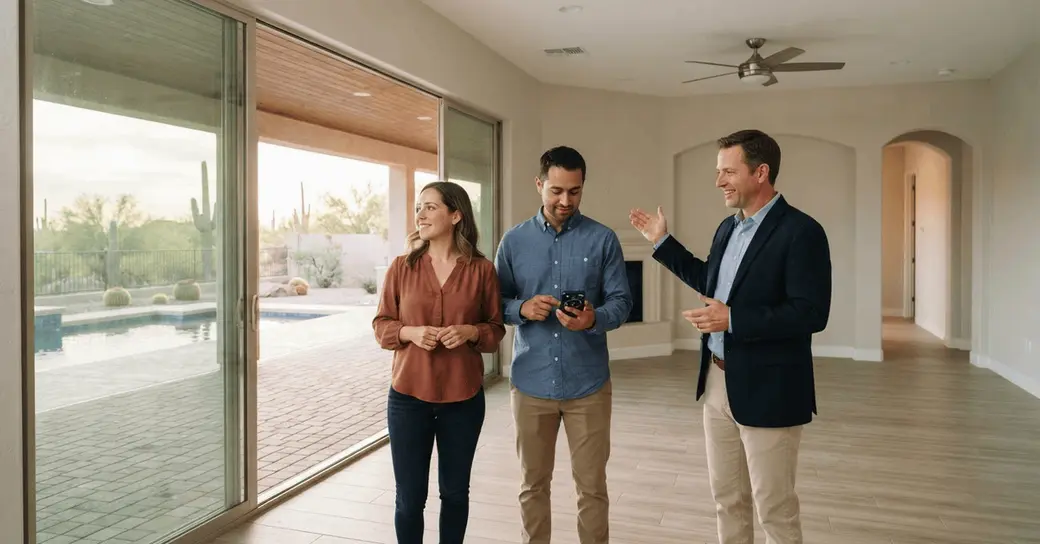

Blog > Moving to Phoenix? How to Check a Home for Summer Heat
If you’re moving to Phoenix and touring homes in November, remember that a house that feels perfect at 75 degrees may feel very different at 115. Summer is when a Phoenix home shows its real character, and you can learn most of it before you ever feel it.
The Phoenix summer is a real adjustment for newcomers, but it is manageable when the home is set up for it. Before you buy this fall or winter, check what a mild-weather tour won’t show: which way the rooms face, how old the air conditioning is, what last summer’s electric bills were, and how water drains during monsoon storms.
- Phoenix summers are long: the National Weather Service counted 70 days at 110 degrees or higher in 2024 and 37 in 2025.
- Ask for 12 months of electric bills and the rate plan. July and August tell you more than any listing description.
- Know the air conditioner’s age. Phoenix systems typically last about 10 to 15 years, and replacement often costs several thousand dollars or more.
- West-facing rooms, unshaded patios and large windows matter more here than almost anywhere else you have lived.
- Check the flood zone and walk the lot’s drainage, even when the yard is bone dry.
How bad is the Phoenix summer for new residents?
It is longer and hotter than most visitors expect, and it is also something residents plan around every year. The National Weather Service’s 2024 Phoenix climate summary counted 70 days at 110 degrees or higher, 143 days at 100 or higher, and 39 nights when the low temperature never dropped below 90. 2025 was milder by comparison, with 37 days at 110 or higher and 122 days at 100 or higher. This past summer, June through August 2026 averaged 97 degrees and ranked as Phoenix’s second-hottest on record, KJZZ reported on September 2, 2026, citing NOAA data.
The nights surprise newcomers most. When it is still in the 90s after dark, the house never really cools off and the AC runs well into the evening. Residents adjust by shifting outdoor plans to mornings and evenings, and the house you choose makes a large difference in how summer feels. That is why I look at a Phoenix home partly as a shelter from the sun, not only as a floor plan. If you have not settled on an area yet, start with how to choose where to live in the Phoenix area; this guide picks up once you are standing inside a specific house.
Which rooms will feel the heat, and how can I tell in November?
Find out which way the house faces and where the afternoon sun lands, because rooms that take the late-day sun keep heating up after the outside temperature peaks. A west-facing bedroom or a wall of glass can feel lovely on a November afternoon; in July, it faces the hottest part of the day.
Open a compass app in the backyard and note which rooms and windows face west and south. Then look for what protects them: covered patios, roof overhangs, shade screens or mature trees. The Department of Energy’s Energy Saver guide to landscaping for shade notes that solar heat absorbed through windows and roofs can increase cooling costs, and that shade on the west side is where the lower late-afternoon sun needs to be blocked. Ask the seller what has been done to the windows (dual-pane glass, sunscreens or window film) and when, and ask your inspector to note the attic insulation. None of this rules a house out; it tells you what you would live with or budget to improve.
How old is too old for an AC unit in Phoenix?
Treat a system that is 10 years old or more as one to inspect carefully and budget for, even if it is blowing cold air on tour day. HVAC.com’s Phoenix air conditioner cost guide (August 20, 2025) says air conditioners in Phoenix last about 10 to 15 years, and it puts a 3-ton condenser paired with an air handler at about $9,500 to $12,500. Angi’s Phoenix AC replacement estimate shows a lower average of $6,892, with most jobs between $5,091 and $8,837. The ranges differ because homes, system sizes and equipment differ, so the number that matters is a quote from a licensed HVAC contractor for the house you are buying.
The data plate on the outdoor unit usually shows a manufacture date, or a serial number an inspector or HVAC technician can decode, and many homes have more than one system. Ask for the installation year and any service records, and consider a separate HVAC evaluation during your inspection period. Our Arizona home inspection guide explains how that fits into your 10 days.
A Mesa family’s experience, reported by ABC15 in July 2023, shows why the age question belongs before closing, not after. The family moved in during 2022 with an air conditioner the station described as old and occasionally noisy, and they had a home warranty. When it stopped working in the summer heat, they waited weeks for repairs, and the unit failed again less than 24 hours after new coils went in, with the house in the mid-to-upper 90s inside. It was eventually fixed. A warranty can help with repairs, but the Arizona REALTORS® Buyer Advisory cautions that pre-existing conditions are generally not covered, so it does not replace knowing the system’s age and condition before you buy.
In Phoenix, working air conditioning is a health and safety system, not only a comfort feature. For a buyer, that risk is a manageable one: know the system before you buy, keep it serviced, and have a plan and a budget for the day it needs work.
What will my summer electric bills be in Phoenix?
The most reliable estimate comes from the house itself: ask the seller, through your agent, for the last 12 months of electric bills, along with the name of the utility and the rate plan. Sellers are not obligated to share them, but many will, and a July or August bill tells you more than any average you will find online.
Most Valley homes are served by APS or SRP, depending on the address, and both use pricing that changes by time of day. APS’s Time of Use 4pm–7pm Weekdays plan charges higher on-peak prices from 4 to 7 p.m. on weekdays, with summer pricing on May through October bills. SRP’s current residential price plans include Conserve 6-9 p.m. and Save and Manage Demand 5-10 p.m. and Save. Those peak hours land right when west-facing rooms are at their hottest, which is why orientation and shade show up on the bill.
Read the bills with the seller’s household in mind: someone who travels all summer uses far less than someone working from home, and solar changes the pattern entirely (see buying a house with solar panels in Arizona). Compare summer months with winter months, and ask what thermostat setting they kept.
Is a bigger home farther out really cheaper in Phoenix?
Sometimes, but the mortgage is only part of the cost. Farther out you can often get more square footage for the money, and every extra room is space you cool from May through October, along with any two-story layout, vaulted ceiling, single-pane window or long west wall.
I would not choose a bigger house without asking what it costs to cool it, and I would add that number to the monthly budget alongside taxes, insurance and any HOA dues. Our guide to how much money you need to buy a house in Arizona covers the upfront side. When you are ready to compare real options, you can search available homes in Phoenix and look at each one through a July lens. If you are still unsure which part of the Valley fits, renting first lets you live through one summer before you commit to a house.
What should I look for in the pool, garage and patio?
Judge these spaces by how you will use them in summer, because they are the ones that feel best in November and change most by July. A pool in full afternoon sun can feel more like warm bath water than a cool-off in August, so notice whether any shade reaches the water and ask the age of the pump and equipment. The Buyer Advisory notes that a home inspector may exclude the pool, so a separate pool inspection may be needed.
Most garages are not air-conditioned, and a west-facing garage takes the full afternoon sun. If you plan to use it as a workshop, gym or storage for anything heat-sensitive, ask about garage door insulation and ventilation. On the patio, stand where you would sit and ask where the shade falls at 4 p.m. in July.
How do I check a Phoenix home for monsoon flooding?
Look up the flood zone first, then look at the lot itself, because summer storms can move a lot of water quickly. The Flood Control District of Maricopa County offers a floodplain viewer and free floodplain determinations, and it explains that if your lender finds the property is in a FEMA 100-year floodplain, you will be required to buy flood insurance. The county also cautions that flood hazards exist in areas that have not yet been documented, so a clean map is not the whole story.
On the lot, check that the ground slopes away from the house, that downspouts and roof drains (called scuppers on flat roofs) send water somewhere sensible, and that the inspector looks for ceiling stains near them. The Buyer Advisory recommends a roof inspection by a licensed roofing contractor when a roof is 10 years old or older. For flood coverage questions, talk with a licensed insurance agent; I can help you find the right questions, but insurance advice belongs with them.
A summer checklist for your November home tour
- Use a compass app to note which rooms, windows and patios face west.
- Photograph the AC data plate on each outdoor unit and ask for the install year and service records.
- Ask for 12 months of electric bills, the utility and the rate plan.
- Ask what has been done to windows, sunscreens, film and attic insulation, and when.
- Ask where the shade falls on the patio and pool at 4 p.m. in July.
- Check the flood zone on the county viewer and walk the lot’s drainage.
- During your inspection period, schedule an HVAC evaluation, plus pool and roof inspections where they apply.
A shaded house with a sound AC system and bills you have seen in advance makes summer a season you plan for, not one that surprises you in your first July.
Frequently Asked Questions
Should I visit Phoenix in July before buying a house?
If you can, yes. Even a few days in July or August show you what afternoons and evenings really feel like. If you can’t, collect summer evidence on each home instead: 12 months of electric bills, the AC’s age, which way the main rooms face, and how much shade covers the patio and windows.
Does a home warranty cover AC replacement in Arizona?
It depends on the contract. The Arizona REALTORS® Buyer Advisory says pre-existing conditions are generally not covered and advises reading the warranty carefully. A warranty can help with some repairs, but it is not a substitute for knowing the system’s age and condition through an HVAC evaluation during your inspection period.
How much does a new AC system cost in Phoenix?
Published estimates vary. Angi shows an average Phoenix AC replacement of $6,892, with most jobs between $5,091 and $8,837, while HVAC.com (August 2025) puts a 3-ton condenser with an air handler at about $9,500 to $12,500. Size, efficiency and ductwork drive the price, so get a quote from a licensed HVAC contractor for the specific home.
Is a west-facing house in Phoenix a bad idea?
Not on its own. A west-facing home takes the strong late-afternoon sun, which can raise cooling costs, but covered patios, overhangs, sunscreens, trees and efficient windows can offset much of it. Look at how well the west side is protected and compare summer electric bills before you decide.
Last updated: November 15, 2026
Tim Tiller, MSW, is a REALTOR® and team leader with Southwest Horizon Real Estate Services at Keller Williams Arizona Realty, focused on North Phoenix, Phoenix relocation, and senior transitions. His social work background shapes how he helps families make major moves, including moves from out of state, with clarity and dignity. Read client reviews.
One client who bought in Phoenix from out of state put it this way: “He “walked” me through all the paperwork, sometimes even by long distance, since I moved to Phoenix from Missouri.” — Judy, RateMyAgent review
If you are relocating and touring homes this fall, send me the houses you are considering along with your budget and commute. I’ll help you gather the summer evidence on each one (orientation, AC age, electric bills and drainage) and line up the right inspections before you commit. Tell me about your Phoenix home search and we can start with the homes on your list.
Tim Tiller, MSW | REALTOR®
Southwest Horizon Real Estate Services
Keller Williams Arizona Realty
602-805-7787 · tim@swhres.com